

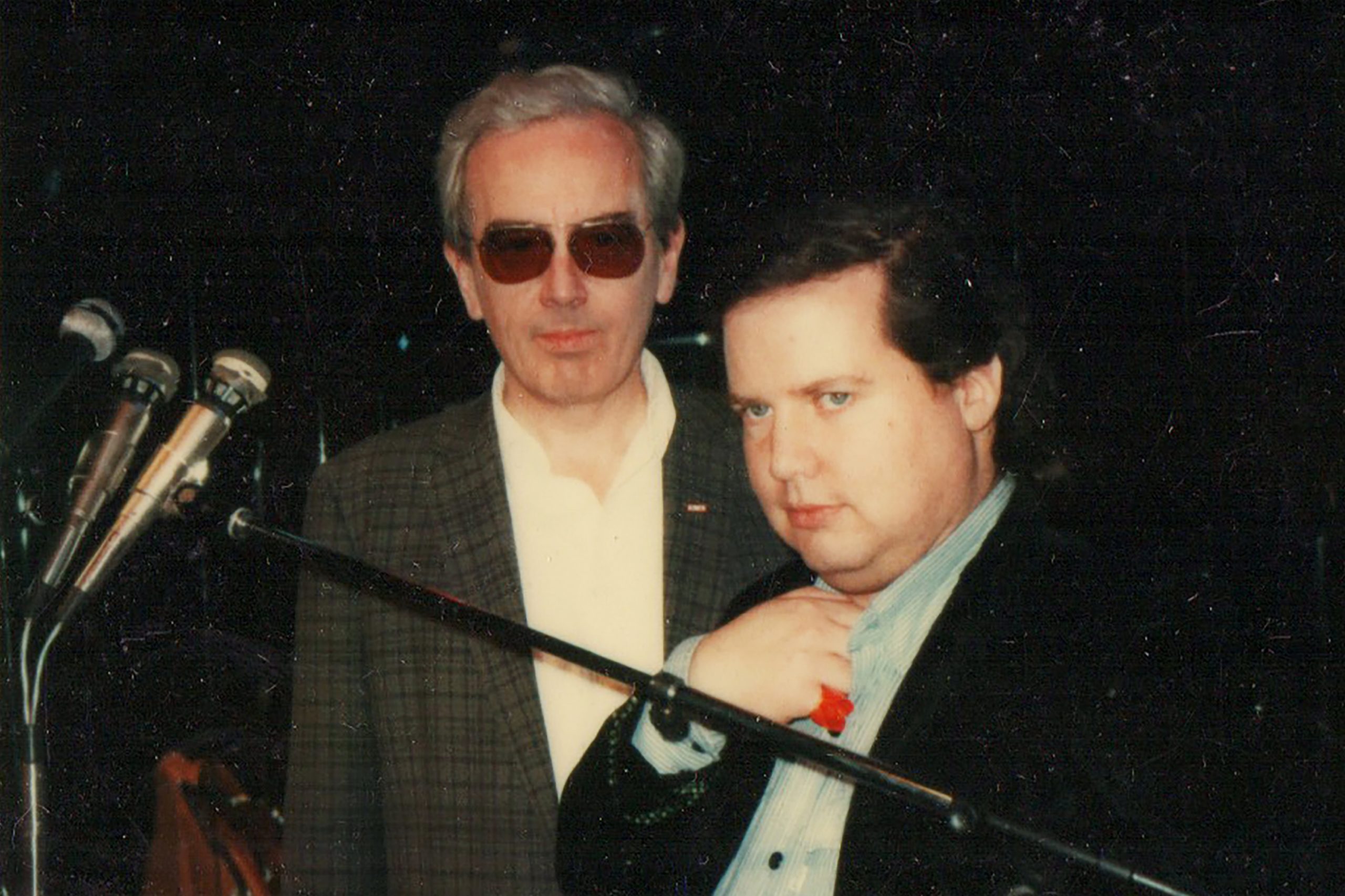
Program
“Blue” Gene Tyranny
Decertified Highway of Dreams (1991)
Robert Ashley
Sonata (Christopher Columbus Crosses to the New World in the Niña, the Pinta and the Santa Maria Using Only Dead Reckoning and a Crude Astrolabe) (1959/1979/1985)
“Blue” Gene Tyranny
The Drifter (1994)
Spirit (1996/2002)
Nocturne With and Without Memory (1989)
Robert Ashley
Viva’s Boy (1991)
Details (2b) (1962)
“Blue” Gene Tyranny
A Letter from Home (2002)
Composers’ Notes
Decertified Highway of Dreams (1991) by “Blue” Gene Tyranny
Route 66 no longer appears on new maps but once stretched across cornfields, deserts, cities to shores from Chicago to Santa Monica, and was the “Gateway to the West” from its birth in 1928 until a last patch near Williams, Arizona was “de-certified” (to use Federal Government cant) in 1984. The highway inspired art and legend about the community of thousands who both traveled it and provided services on the way. This composition, based on winding melodies created for an early version of the audio-storyboard The Driver’s Son, describes a search, where intuition jogs back and forth with intention.
Several techniques generate the rhythmic and harmonic structures—the call-and-response, telegraphic introduction (the “tune-up”) employs a steady rhythmic shifting (a “mobile”) in simple 4/4 meter; hocketing rhythms create a stereo bouncing effect (“something in the air”); and modified serial techniques gradually modulate the primary harmonies into rich dissonances, and modify the rhythms from smooth linear progressions to severe angularities (“potholes,” “stalled in traffic,” “pulled over by the trooper”). Timbre contrasts help to evoke changing imagery (“roadside attractions,” etc., the specifics provided as always by the listener), while long streams of melody (“joyrides”) stretch out into the vast distance.
Sonata (Christopher Columbus Crosses to the New World in the Niña, the Pinta and the Santa Maria Using Only Dead Reckoning and a Crude Astrolabe) (1959/1979/1985) by Robert Ashley
When “Blue” Gene Tyranny asked me, in 1979, for a score of the Sonata, in order to record it for his album, Just for the Record, I still had not decided how to compose the second and third sections. When the Sonata was begun, twenty years earlier, I knew what those sections should be, but I could not find the inspiration to compose them. Every idea was discarded, because I could not escape from the pattern of a drama of contrasts, while what I had in mind was a “one movement” sonata, followed by two (or more) sections that made up a kind of “deconstruction of” the basic idea (though I didn’t know that terminology then.)
I explained this predicament to “Blue” Gene by telling him about the image I had always used as a guide for what the other sections should sound like—the schoolbook image of the legendary ocean crossing in three ships that are essentially alike; the image of two following one, but “on either side” and, thus, essentially interchangeable; the image of the two as “shadows of” or “in the shadow of” the one.
Naturally, as soon as I had a chance to say these things to someone who was interested, the problem solved itself, and I knew exactly how to proceed. So, it was “Blue” Gene’s interest in the Sonata that caused me to be able to finish it. I am happy to dedicate this score to him.
As a result of our talking about the “guiding” image, “Blue” Gene came up with the idea of recording the second and third sections and replaying them, together, during the performance of the first section. This is a wonderful interpretation of the “shadow” part of the image, and it also confirms the principle of the accumulation of sounds that governs the composition. Moreover, it works perfectly with the feeling I had always had to bring the audience closer to the enormous dynamic range of the piano and, thus, to clarify the role of dynamics in the composition.
In “Blue” Gene’s recording he performs the Sonata in both interpretations: first, the three sections are played in order, then, 1 is replayed and mixed with the recordings of 2 and 3. For concert performances I will leave the choice among these interpretations (and their possible combinations) to the taste of individual pianists.
The Drifter (1994) by “Blue” Gene Tyranny
Composed for pianist Joseph Kubera, this piece was inspired by a description of the megaliths near Lake Pang-gong in Tibet. The purpose of these structures remains unknown. I imagined an unnamed wanderer moving among these quartz pillars of mysterious origin which are laid out in 18 rows, with circles of stones at the ends of each row. The form of this ancient structure is imitated in the music by 5-note chords arranged in 3-pair sets in 3 sections, each section a transformation of the previous one, for a total of 18 chords. The “free reading” heard here is based on material from two of the three contrapuntal layers.
Spirit (1996/2002) by “Blue” Gene Tyranny
In Henry Cowell’s 1930 book New Musical Resources he describes how to create natural and artificial harmonics on the piano. Natural harmonics, of course, are produced by soundlessly depressing keys in the right hand and playing and then releasing the same audible chord only an octave lower producing a ringing of those harmonics another octave higher. For artificial harmonics, however, the chord that is actually struck is an octave lower and a half step higher than the soundless chord in the right hand. This produces a very strange and unexpected series of tones that has an ethereal quality that is rarely used in composition. It’s difficult to project to an audience but is easily heard by the pianist. To create Spirit, both of these harmonics were recorded and then artificially one was edited by computer to remove the loud striking of the left hand and only the otherworldly harmonics are left. These often sound as if they are electronically produced but in fact it is all made from this process. The progression of chords is followed by normal piano playing in various modes or scales in live performance while a recording of the harmonics is played at the same time. The title Spirit is a poetic reference to Cowell’s composition, The Banshee, which is the name of a spirit-like figure in Irish mythology. The prepared sounds are placed at large intervals to give the live concert pianist the opportunity to improvise piano lines based on those chords. The sound is often surprising.
Nocturne With and Without Memory (1989) by “Blue” Gene Tyranny
The Nocturne With And Without Memory describes events that resonate from the day into the evening, the time of the nocturne, overlapping with sounds present at the moment, relatively without memory, or resonance.
The first movement of this piece was written keeping the image described above in mind. This movement was gradually “grown” by playing at the piano, writing down what was played, then always starting over from the beginning. The idea of overlapping resonate notes from chords with non-resonate gestures was kept in mind. The first “character” that appeared was a descending/ascending chord passage, the second character was a melodic figure, and the third was an internally-active, arpeggiated motion discovered later.
The two following movements formally re-scan or re-read, the first movement using two different methods:
The second movement is a loose retrograde, a “dusty mirror” of the first movement, with the middle or accompaniment voices brought to the foreground. Surprising combinations and variations of gestures were discovered by using this method.
The third movement is a “glyph”—a cloud of available, pre-composition notes and articulations, independent of their emotional expression. The notes and articulations are taken from the first movement and arranged in their closest position, independent of harmony and melodic direction. Therefore, the notes generate scale-like passages that may recall a simple, ancient time, or a peaceful, contemplative evening.
This piece was composed in Durham, North Carolina and Brooklyn, New York, February–May 1989.
Viva’s Boy, from eL/Aficionado (1991) by Robert Ashley
eL/Aficionado is a group of scenes from the life of an “agent.” The scenes are a kind of “debriefing” to a jury of Interrogators, in which the Interrogators (chorus) challenge the Agent (soloist) in various forms of musical dialogue. The mood of the opera owes much to our fascination with espionage and with the character of those people who lead double lives.
I am indebted to “Blue” Gene Tyranny for his work throughout the development of eL/Aficionado both as a singer and as a pianist, and to him and to Joseph Kubera as pianists in the concert version of the work that was performed for three years prior to finishing the electronic orchestra.
The version of “Viva’s Boy” on this concert is from the original two piano version of the opera.
Details (2b) (1962) by Robert Ashley
The essence of Details was: the influence each player asserted on the other’s choice of action—and the area of unpredictability of actual sound resulting from a (chosen) planned action.
This work represents one example of my investigation of peculiarities of the relationships among players. I was interested not so much in isolating these peculiarities in the service of technology (to learn to control them and apply them more efficiently) but to “amplify” them for purposes of art.
[The performers] are separately (but simultaneously) composing a group of sounds with only some details of which they can “control,” i.e. they are composing their minds around the interaction of their individual intentions and the “environment.”
A Letter from Home (1976/2002) by “Blue” Gene Tyranny
Scored originally for voices and electro-acoustic instruments. [A Letter from Home] is a procedural score with harmonic, melodic, rhythmic, and verbal materials that may assemble in different ways.
The first realization (1976) was made for [the Lovely Music record Out of the Blue]. The uniting structure that underlies both text and music is the Doppler Effect (simultaneous amplitude, phase, frequency, and time modulation) presented as a metaphor for the development of consciousness (with the unchanging sense of presence as “home base”). This first recorded version begins with the sound of a train passing that exhibits all the characteristics of the Doppler Effect; various acoustic instruments were added to emphasize the translation from natural to acoustic sound.
The music develops through a tree of “branching harmonics”: the basic progression (I, V, IV, I, II#, IV) is constantly transformed as the harmonic of one fundamental root becomes the new fundamental root and generates new harmonics (and chord voicings), and so on. This process seems to be one of natural growth and spacetime distortion. These harmonies are heard both in their steady development and in non-metric “smears”—increasingly longer “trains” of chords that pass through the stereo space (emulating the actual train heard at the outset of the piece).
From these harmonies, simple signature melodies are generated, and gradually more complex rhythms are generated (in “current” and “accumulating” modes), and the emotional “meaning” or tension of the constant drone changes as it is surrounded by new harmonies.
There have been several other realizations of this score since the original. In 1986, a new rhythmic text was tried out with stories in three sizes (biographical, historical, micro-level) with tableaux vivante (kitchen scene, sitting on a ranch fence, etc.) beautifully staged by the Otrabanda Theatre Co. In 1991, an instrumental version for piano, marimba and vibraphone was made using the melodic, ascending harmonic, and rhythmic material. Also in 1991, a kind of rock version for piano and two electric guitars playing the “current rhythm” and “accumulating rhythm” parts was created. In 1996, the chart of “branching harmonics” was used as the wellspring for a piano improvisation with dancers Trisha Brown and Steve Paxton. In 2002 this same chart was the basis of a piano improvisation on the CD Take Your Time.
About Sarah Cahill
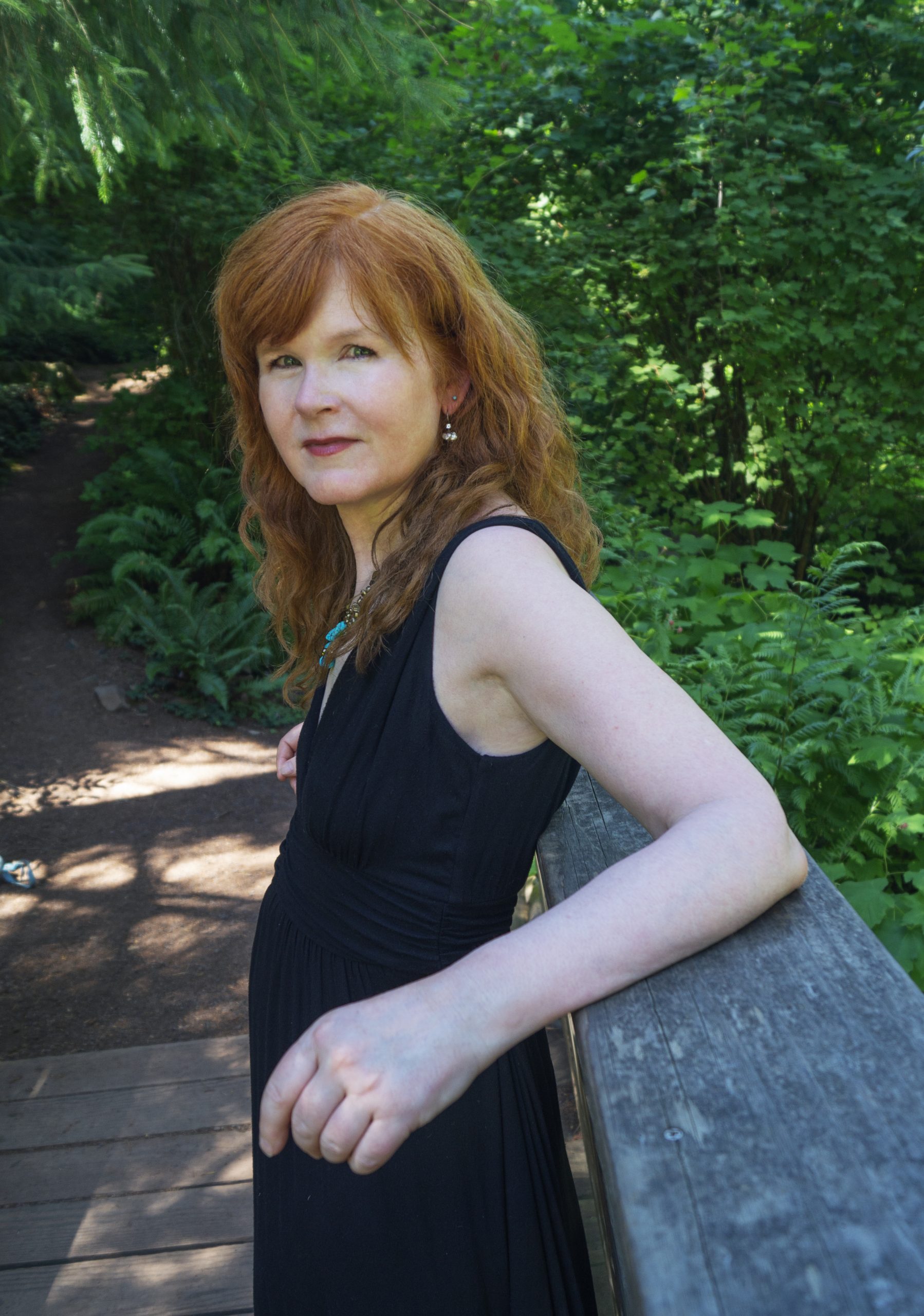
Sarah Cahill, hailed as “a sterling pianist and an intrepid illuminator of the classical avant-garde” by The New York Times, has commissioned and premiered over seventy compositions for solo piano. Composers who have dedicated works to her include John Adams, Annea Lockwood, Terry Riley, Frederic Rzewski, Pauline Oliveros, Julia Wolfe, Roscoe Mitchell, and Ingram Marshall. She was named a 2018 Champion of New Music, awarded by the American Composers Forum (ACF). Recent performances include The Barbican Centre in London, The National Gallery of Art, Detroit Institute of Arts, Black Mountain College Museum + Arts Center, and an NPR Tiny Desk concert. She recently premiered Viet Cuong’s piano concerto, Stargazer, with the California Symphony. Sarah’s recordings include Lou Harrison’s Concerto for Piano with Javanese Gamelan, recorded at the Cleveland Museum of Art with Evan Ziporyn, Jody Diamond, and Gamelan Si Betty, and Eighty Trips Around the Sun, a four-disc tribute to Terry Riley. Sarah’s radio show, Revolutions Per Minute, can be heard every Sunday evening from 6 to 8 pm on KALW 91.7 FM in San Francisco. She is on the faculty of the San Francisco Conservatory and is a regular pre-concert speaker with the San Francisco Symphony and the Los Angeles Philharmonic.
About Joseph Kubera
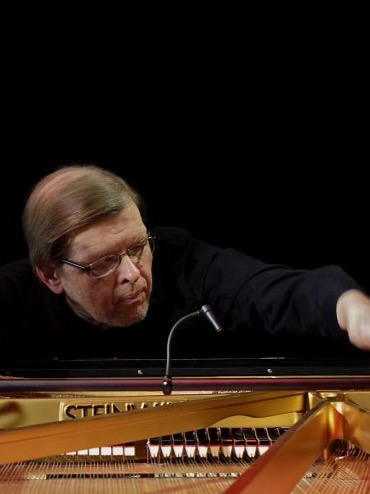
Praised in The Wire (UK) for his “instrumental athleticism, technical precision and conceptual lucidity,” and his “capacity to stretch limits and redefine horizons,” Joseph Kubera has been a leading new music pianist for the past four decades. Recently he played at De Singel in Antwerp, at the “Christian Wolff at 90” celebration in New York, and recorded piano music by Laurie Spiegel, Daniel Goode, and Lejaren Hiller. He has directed performances of Julius Eastman’s music in New York, Los Angeles, and Philadelphia, and has worked closely with such luminaries as Morton Feldman, Julius Eastman, Robert Ashley, and La Monte Young. Composers who have written works for him include Larry Austin, Michael Byron, Anthony Coleman, Alvin Lucier, Roscoe Mitchell, and “Blue” Gene Tyranny.
A longtime Cage advocate, Kubera has made definitive recordings of Music of Changes and the Concert for Piano and toured widely with the Merce Cunningham Dance Company at Cage’s invitation. He has worked with S.E.M. Ensemble, Steve Reich and Musicians, and myriad other ensembles in New York City. In addition to his work with Sarah Cahill, he has collaborated with pianists Adam Tendler and Marilyn Nonken and baritone Thomas Buckner. Kubera has been awarded grants through the NEA and the Foundation for Contemporary Arts. He has recorded for Wergo, New Albion, New World, Lovely Music, Tzadik, and many other labels.