

A David Tudor Centennial
Composers Inside Electronics
Friday Concert, June 26th, 2026 at 7:30 pm
Saturday Workshop, June 27th, 2026 at 1:00 pm
Saturday Concert, June 27th, 2026 at 7:30 pm
Littlefield Concert Hall, Mills College at Northeastern University, Oakland
Composers Inside Electronics
Friday Concert, June 26th, 2026 at 7:30 pm
Saturday Workshop, June 27th, 2026 at 1:00 pm
Saturday Concert, June 27th, 2026 at 7:30 pm
Littlefield Concert Hall, Mills College at Northeastern University, Oakland
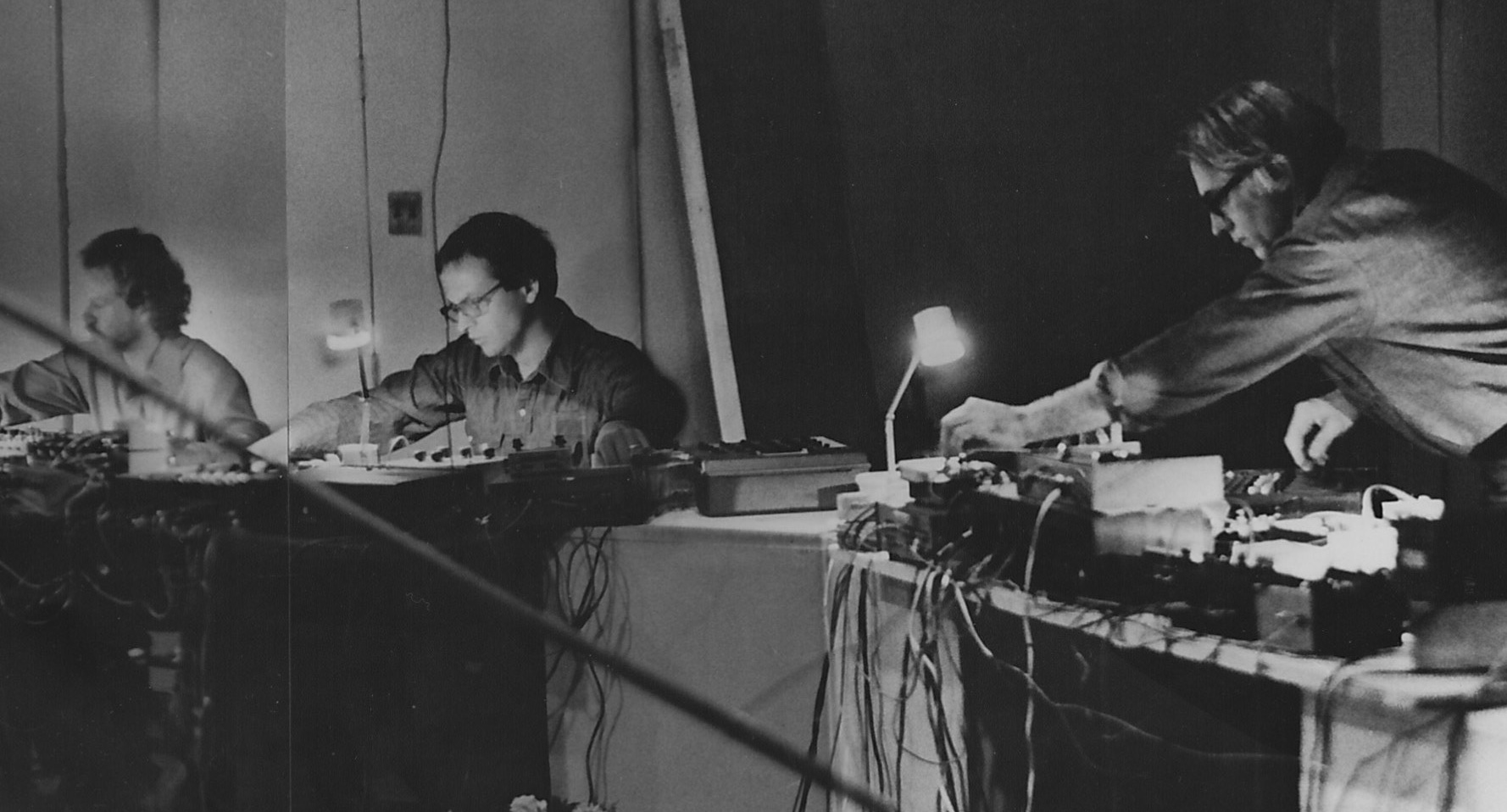
Other Minds holds certain truths to be self-evident—what better way to celebrate the American semiquincentennial than with summer concerts featuring Maverick American Composers from distinct eras of musical history? For the first concert of Mavericks 250, Other Minds welcomes Composers Inside Electronics to perform works by David Tudor (1926–1996) in celebration of his centennial, as well as Composer Inside Electronics 50th Anniversary. This event takes place over two evening concerts, as well as an afternoon discussion/demonstration of some of the techniques behind Tudor’s experiments with electronics.
David Tudor is, perhaps, most famously known as part and principal interpreter of the New York School—John Cage, Morton Feldman, Earle Brown, and Christian Wolff. With Cage, in the early 1960s, Tudor also began to pioneer the use of live electronics in performance, as opposed to exclusively on recordings. To further this practice, Tudor formed Composers Inside Electronics 1973, whose original core members, along with Tudor, were John Driscoll, Paul DeMarinis, Phil Edelstein, Linda Fisher, Ralph Jones, Martin Kalve, and Bill Viola. Their first work was a collaboratively realized “electroacoustic environment” conceived by Tudor: Rainforest IV. This first version of the group was active between 1976 and 1981. Reformed in 1996 for Tudor’s memorial service, current members include John Bischoff, Paul DeMarinis, John Driscoll, Michael Johnsen—and during the performances they will be joined by James Fei.
Composers Inside Electronics’ performance is sponsored by a generous donation from the David Tudor Project – Performing Artservices, Inc.
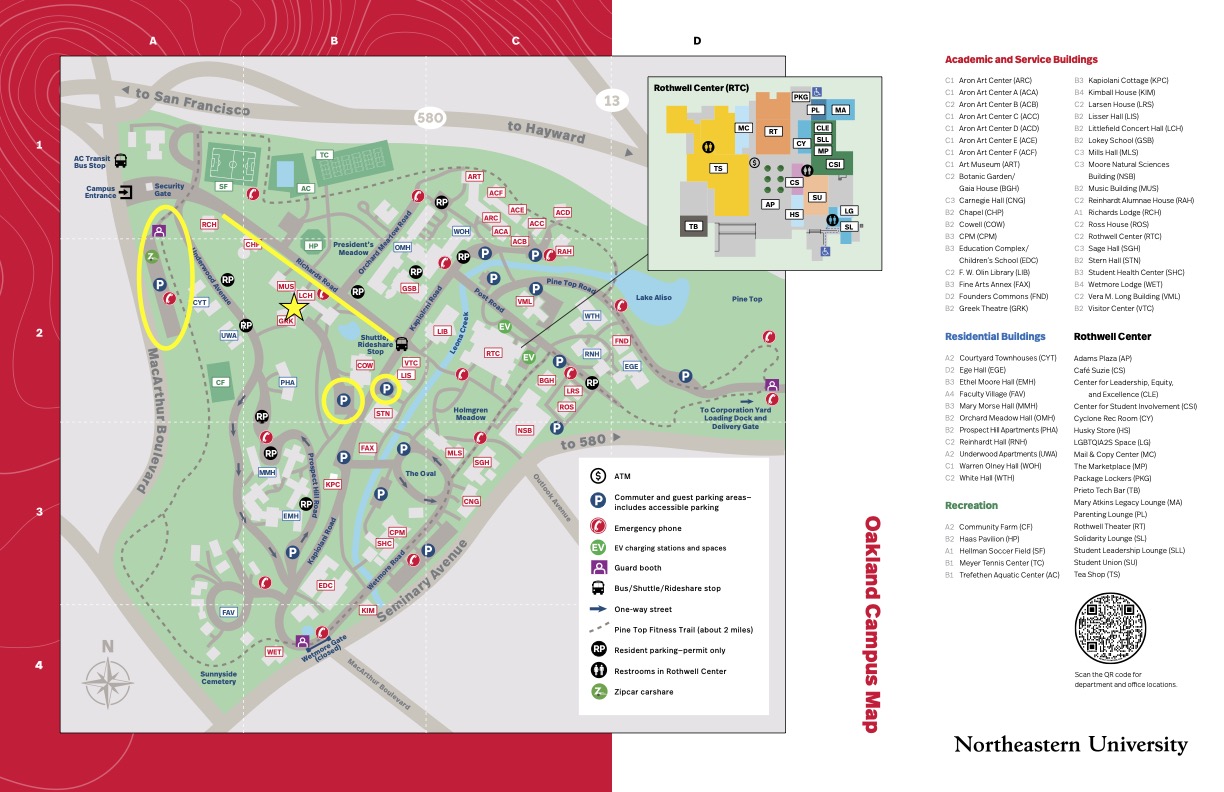
Public parking is indicated on the campus access map below. The best areas for the Concert Hall are:
- Richards Rd (which runs along in front of the hall)
- Richards Lot (to the right immediately upon passing the entrance gate)
- Lisser Lot
- Cowell Lot
We are unable to reserve parking. There is one ADA spot on Richards Rd, two ADA spots in Lisser lot.
Please note Campus Access Policy:
Northeastern University is committed to providing a safe and secure environment for the university community, visitors, and guests.
All vehicle drivers and pedestrians entering campus will be required to identify themselves and state their business on campus at all hours. All vehicle drivers are expected to make a full stop at the stop sign and present government-issued ID to the gate officer.
All persons entering campus between 8:00 p.m. and 5:00 a.m. are required to sign-in and present a Husky Card or a government-issued ID at the Richards Road gate.
Accepted government-issued IDs are state or provincial driver’s license or identification card, passport or passport card, military ID card, or permanent resident card. ID will be requested from the driver of a vehicle and from individuals entering on foot.
Any individual unable to present an accepted ID will not be granted access to campus. Please allow yourself extra time when accessing campus to accommodate the Campus Access Policy.
More information to assist you in traveling to Mills College at Northeastern University is linked here.
If you have any questions, please contact – millsperformingarts@northeastern.edu
Friday June 26 Concert Program
Evening: 7:30 PM
David Tudor
Forest Speech
David Tudor
Untitled
Saturday June 27 Concert Programs
Afternoon: 1:00 PM
Discussion/Demonstrations of David Tudor’s Microphone and Pulsers, and John Driscoll’s Speaking in Tongues.
Evening: 7:30 PM
David Tudor
Microphone
David Tudor
Pulsers
John Driscoll
Speaking in Tongues
About Composers Inside Electronics

John Bischoff (b. 1949, San Francisco) is an early pioneer of live computer music. He is known for his solo constructions in real-time synthesis as well as the development of computer network music. His recent performances combine hands-on analog circuitry and digital synthesis in open dialog. The ebb and flow of discontinuity in these systems spontaneously generates form. He has performed all around the US, and in Europe at the Festival d’Automne in Paris, Akademie der Künste in Berlin, STEIM in Amsterdam, and Fylkingen in Stockholm among other places. He is a founding member of the LEAGUE OF AUTOMATIC MUSIC COMPOSERS and co-authored an article on the LEAGUE’s music that appeared in Foundations of Computer Music (MIT Press 1985). He is also an original member of THE HUB. In 1999 he received a Foundation for Contemporary Arts award, and as a member of the HUB he received a GigaHertz Prize for lifetime achievement in Electronic Music in 2018 by ZKM in Karlsruhe, Germany. Recordings of his work are available on Artifact Recordings, Lovely Music, Tzadik, 23Five, Centaur, Relative Pitch, and New World Records. He was on faculty for many years in the legendary Music Department at Mills College, in Oakland, CA.
Paul DeMarinis has been making noises with wires, batteries, and household appliances since the age of four. He has worked in the areas of interactive software, synthetic speech, noise, and obsolete or impossible media. He has performed internationally, at The Kitchen, Festival d’Automne a Paris, Het Apollohuis in Holland, at Ars Electronica in Linz, and created music for Merce Cunningham Dance Co. His interactive artworks have been shown at the I.C.C. in Tokyo, Bravin Post Lee Gallery in New York, and The Museum of Modern Art in San Francisco. He has been an Artist-in-Residence at The Exploratorium and at Xerox PARC. Major awards include a Fellowship from the John Simon Guggenheim Foundation, the Rockefeller Foundation New Media Award, the D.A.A.D. Berlin Artist Fellowship, and the Golden Nica Award by Ars Electronica in 2006. Much of his work involves speech processed and synthesized by computers, available on the Lovely Music Ltd. compact disc Music as a Second Language, the Apollohuis CD A Listener’s Companion and the LP Songs without Throats on Black Truffle. Major installation works include The Edison Effect—that uses optics and computers to make new sounds by scanning ancient phonograph records with lasers, Gray Matter—that uses the interaction of body and electricity to make music, and The Messenger and Firebirds—that examine the myths of electrical communication. Public artworks include large scale interactive installations at Park Tower Hall in Tokyo, at the 1996 Olympics in Atlanta and at the world Expo in Lisbon.
John Driscoll is a composer/sound artist and a founding member of Composers Inside Electronics (CIE) who has collaborated on David Tudor’s Rainforest IV project since its inception in 1973. He has toured extensively with: CIE, David Tudor, Phil Edelstein, Douglas Dunn & Dancers, Stephen Petronio Dance Co., and as a solo performer. He has been artist-in-residence at DAAD (Berlin) and at Mills College (Oakland) and the Exploratorium (S.F.). His work has focused on robotic rotating loudspeaker instruments, compositions and sound installations for unique architectural spaces, and music compositions for dance (Merce Cunningham Dance Co., Douglas Dunn, Maida Withers and the Dance Construction Co.). He collaborated with Phil Edelstein on Rainforest V (variations 1-4) acquired by MoMA (NY), Museum der Moderne (Salzburg), Arter Museum (Istanbul), and MAC (Lyon) (2015-2019), and has collaborated with Edelstein on a sound installation series Cluster Fields (2018–present). His work with unique ultrasonic instruments has resulted in multiple works including a performance work Speaking in Tongues and an installation work Slight Perturbations. His most recent sound installation collaboration is Gestures/Mumurations (2024) with Cecilia Lopez.
James Fei (b. Taipei, Taiwan) moved to the US in 1992 to study electrical engineering but lost his way in music, becoming a composer, saxophonist, and electronic musician. Works by Fei have been performed by the BBC Scottish Symphony Orchestra, Orchestra of the S.E.M. Ensemble, Bang on a Can All-Stars, and Noord-Hollands Philharmonisch Orkest. Recordings can be found on Leo Records, Improvised Music from Japan, CRI, Krabbesholm, and Organized Sound. Compositions for Fei’s own ensemble of four alto saxophones focus on physical processes of saliva, fatigue, reeds crippled by cuts, and the threshold of audible sound production, while his sound installations and performance on live electronics often focus on electronic and acoustic feedback. Fei received the Grants for Artists Award from the Foundation for Contemporary Arts in 2014 and he is president of the Tri-Centric Foundation. Fei taught at Mills College from 2006 to 2026.
Michael Johnsen is a circuit designer, performer, and researcher from Pittsburgh. His recent scholarship forms a circuit-level understanding of David Tudor’s “folkloric” homemade instruments. This work has resulted in restoration, cloning, and performance with vintage circuits, as well as publications/lectures. His own performance work is characterized by a relative lack of ideas per se, and an intense focus on observation, the way a shepherd watches sheep. As a performer/builder of live-electronics he cultivates an integrated menagerie of custom devices whose idiosyncratic behaviors are revealed through their complex interactions, producing teeming chirps, sudden transients and charming failure modes; embracing the dirt in pure electronics. He has shown work at arter (Istanbul), singuhr (Berlin), INA GRM (Paris), Getty [LA], MdM Salzburg, Kagurane (Tokyo), MoMA, SF Cinematheque, Radio France, Idiopreneurial Entrephonics (CT), Kitchen (NYC), High Zero (Baltimore), and Musique Action. He co-edits ubu.com/emr and designs synthesizers for Pittsburgh Modular.
About David Tudor
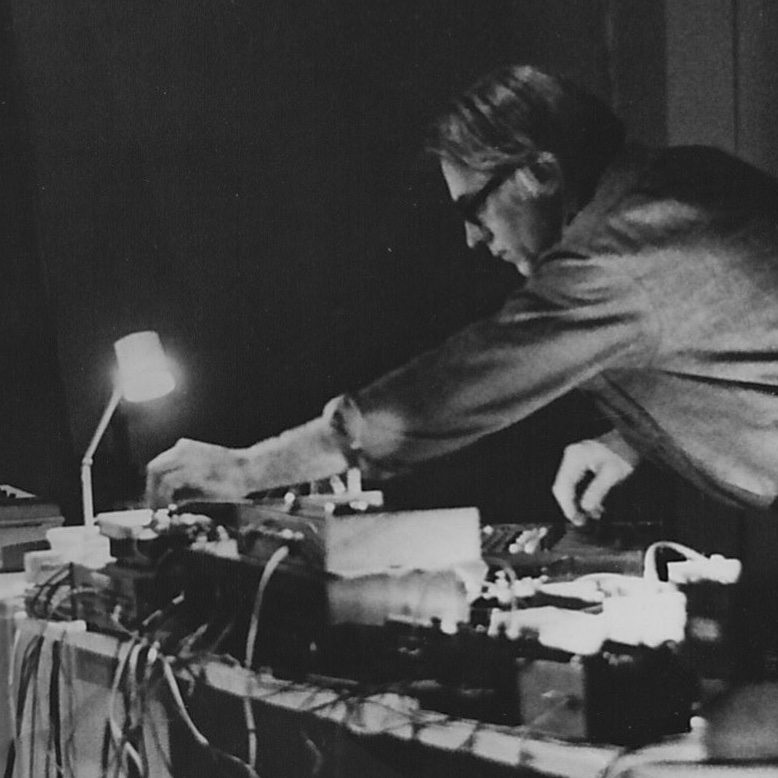
David Tudor’s (1926–1996) first professional activity, at 16, was as an organist. He became a leading avant-garde pianist, with highly acclaimed first performances of compositions by contemporary composers, before moving in the mid-1960s to the composition and performance of “live electronic music.” In the early 1950s, at Black Mountain College and in New York, he formed relationships with artists with whom he continued to work during his entire career—John Cage, Merce Cunningham, Robert Rauschenberg, Christian Wolff, and others. He became the pianist for the Merce Cunningham Dance Company and he and John Cage toured during the 1950s and early 1960s with programs of Cage’s works. In the late 1950s he had an important presence at Darmstadt, where he worked with and influenced Karlheinz Stockhausen, Cornelius Cardew, and other members of the European avant-garde. His own compositions appeared in the mid 1960s: Bandoneon ! (1966), a composition for “Nine Evenings, a project of Experiments in Art and Technology (E.A.T.)”; design and composition of the Pepsi Pavilion, Expo ’70, Osaka, Japan, also an E.A.T. project: and, from 1976, as a founding member of Composers Inside Electronics, a music ensemble whose members perform collaborative compositions with home-built electronic circuitry. Tudor’s first composition for the MCDC was for Cunningham’s Rainforest in 1968. Tudor assumed the post of Music Director of MCDC in 1992. Tudor’s last work for Cunningham was Soundings: Ocean Diary, the electronic component of the score for Ocean (1994).